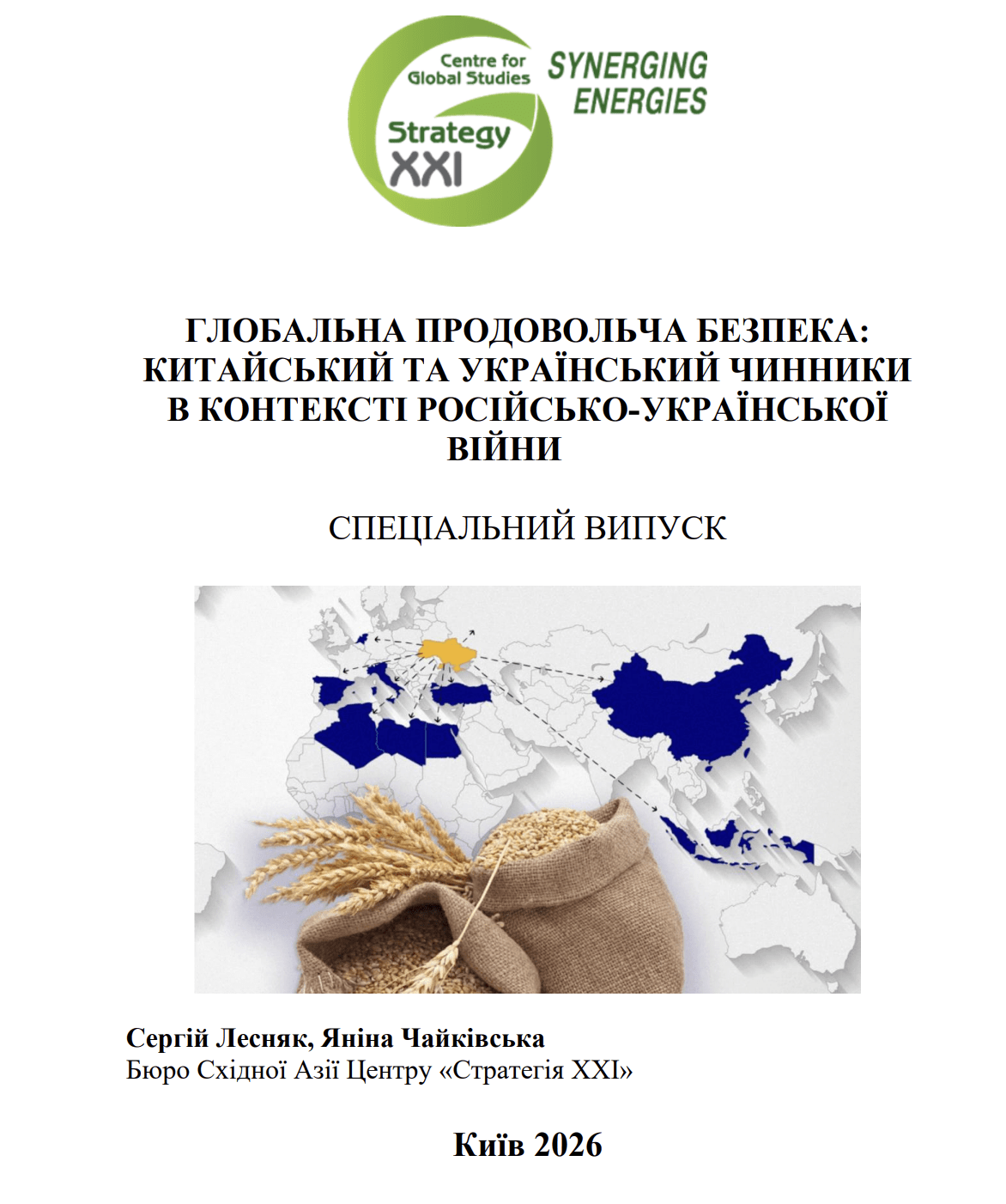
In the study "Global Food Security: Chinese and Ukrainian Factors in the Context of the Russian-Ukrainian War", the authors, experts of the Center for Global Studies "Strategy XXI", Serhiy Lesnyak and Yanina Chaykivska, analyzed in detail the current state, trends and key destructive factors that determine the dynamics of global food security.
The study highlights the systemic risks associated with the high concentration of global production and export of basic agricultural crops (wheat, corn, rice, soybeans) among a limited number of leading countries (USA, Brazil, Netherlands, India, Ukraine, Argentina, etc.). The balance of markets and forecast indicators of production and consumption of grains, oilseeds, meat, fish and fertilizers for the 2025-2027 season are studied. Special attention is paid to a comprehensive analysis of Ukraine as one of the key guarantors of global food security, whose agricultural exports in the first half of 2026 showed recovery trends.
Based on an analysis of the latest international reports (FAO, SOFI, Global Report on Food Crises, SIPRI, WTO), the synergistic impact of climate change, armed conflicts, demographic shifts, and inflationary pressures on food availability in vulnerable regions of Asia and Africa is revealed. China's large-scale food strategy is examined in detail, in particular, legislative provisions on the protection of arable land (the "Food Security Guarantee Law" of 2024, the draft "National Reserve Security Law" of 2026), the strategic accumulation of state reserves, the use of tariff rate quota mechanisms (TRQ) and state trading companies (COFCO). The authors also paid attention to the policy of harmonizing agricultural imports with domestic production.
In addition, the paper examines Russia’s aggressive food strategy, which combines tough domestic protectionism (embodied in the Food Security Doctrine) with the use of agricultural exports as a geopolitical tool of influence. It analyzes Russia’s attempts to reorient grain and fertilizer supplies to the markets of the Global South to strengthen the loyalty of developing countries, as well as the systematic use of non-tariff barriers, export duties, and manipulation of world prices to crowd out competitors, including Ukraine.
The conclusions outline the importance of supply chain diversification, technological innovation, and international cooperation for stabilizing global commodity markets.
You can read more about the study in the PDF file below.